ANGIOGENESIS
The term ‘‘Αngiogenesis’’ defines the formation of new blood vessels from pre-existing ones, a process that is distinct from ‘‘Vasculogenesis’’ describing the de novo generation of new vessels in the embryo from the differentiation of endothelial precursors, named angioblasts, into a primitive vascular plexus. Physiological angiogenesis is a strictly regulated finetuned process. The local balance between inducers and inhibitors of angiogenesis is critical in determining the generation or not of new vessels. Whenever this balance is perturbed pathological, uncontrolled, excessive angiogenesis occurs. Psoriasis, rheumatic arthritis and diabetic retinopathy constitute some of the diseases in which pathological angiogenesis contributes to their pathogenesis. However, tumor angiogenesis is the most striking manifestation of abnormal angiogenesis. Indeed, it has been demonstrated that formation of new blood vessels is required for tumor growth beyond a diameter of 1-2 mm.

Tumour angiogenesis
Solid tumours initiate angiogenesis to support their growth by producing growth factors such as VEGF. Depriving the tumour of the excessive vessels that support its growth became the target for developing anti-angiogenic agents that could provide, in combination with chemotherapy, improved anti-cancer treatment. Naturally most agents targeted VEGF and its signalling cascades. Almost 10 years have lapsed since the first anti-angiogenic drug approved by the FDA in 2004 (a humanized antibody inhibiting VEGF-A) and several other agents followed afterwards. There is sufficient accumulated experience to conclude that the clinical results of anti-angiogenic therapy are very modest resulting in moderate improvement in overall survival. Moreover, the clinical outcome is associated with the development of resistance to the anti-angiogenic agent and the increased risk of invasion and metastasis. The initial expectations are, as yet, unfilled, and the entire concept and strategy of the anti-angiogenic intervention in cancer requires re-evaluation.
Effect of VEGF and anti-VEGF treatment on endothelial cells and pericytes.
S. Bellou, G. Pentheroudakis, C. Murphy, T. Fotsis, Anti-angiogenesis in cancer therapy: Hercules and hydra, Cancer Letters, Volume 338, Issue 2, 2013, Pages 219-228, ISSN 0304-3835, https://doi.org/10.1016/j.canlet.2013.05.015.
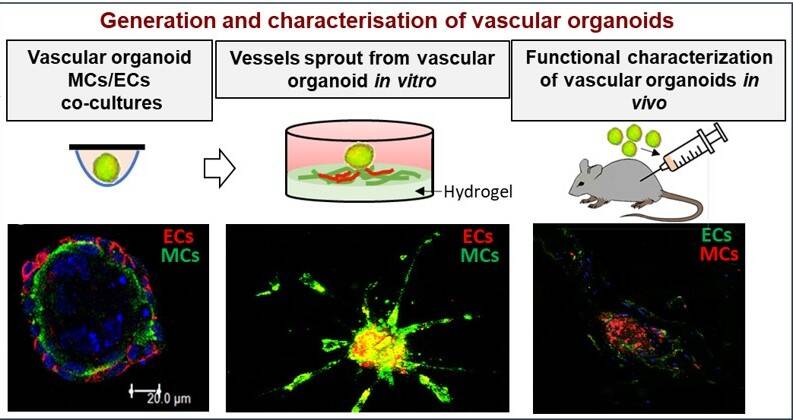
Vascular organoids
Mural Cells (MCs) are committed to stabilize the vasculature by paracrine and cell-cell interactions with neighboring ECs . We study the role of synthetic and contractile Smooth Muscle Cells in the endothelial cell (EC) network in order to investigate the use of these cells in tissue engineering applications.

Flavonoid effect on tumour angiogenesis
Luteolin and other flavonoids found in plant-based diets inhibit cancer progression by suppressing angiogenesis (blood vessel growth). We have shown that a single flavonoid, luteolin, can specifically block VEGF-induced angiogenesis and significantly reduce tumor volume in animal models. Therefore, the anti-angiogenic properties of these phytochemicals are a key factor in the cancer-preventive effects of plant-based diets.
Luteolin inhibits tumor growth and angiogenesis
Bagli E, Stefaniotou M, Morbidelli L, Ziche M, Psillas K, Murphy C, Fotsis T. Luteolin inhibits vascular endothelial growth factor-induced angiogenesis; inhibition of endothelial cell survival and proliferation by targeting phosphatidylinositol 3'-kinase activity. Cancer Res. 2004 Nov 1;64(21):7936-46. doi: 10.1158/0008-5472.CAN-03-3104. PMID: 15520200.
