Research Areas
Human pluripotent stem cell biology and applications

Human embryonic stem cells grown on micropatterned 3D surfaces (blue-Hoechst)
We investigate the fundamental biology and translational applications of stem cells, with particular emphasis on induced pluripotent stem cells (iPSCs) derived from patients carrying different mutations related to diseases. Our research focuses on differentiation protocols towards the three lineages, especially towards vascular progenitor cells through mesodermal intermediates.
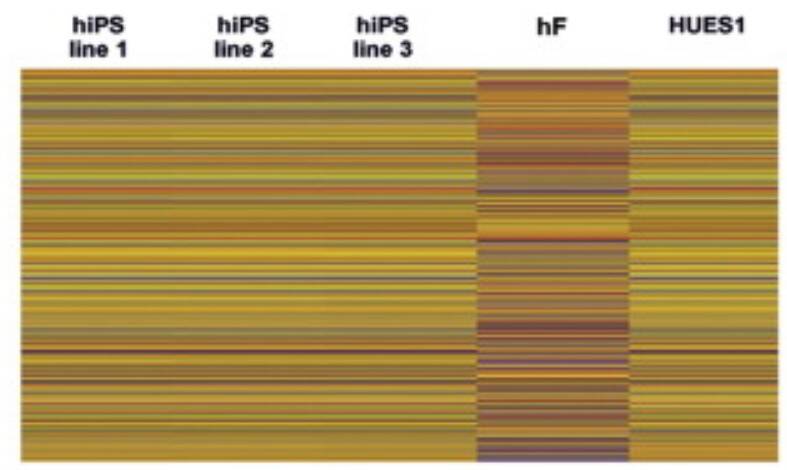
Heat map analysis of the differentially regulated genes following reprogramming among hiPSC lines, original human fibroblasts (hFs) and embryonic HUES1 stem cell line.
Three-dimensional (3D) cellular systems
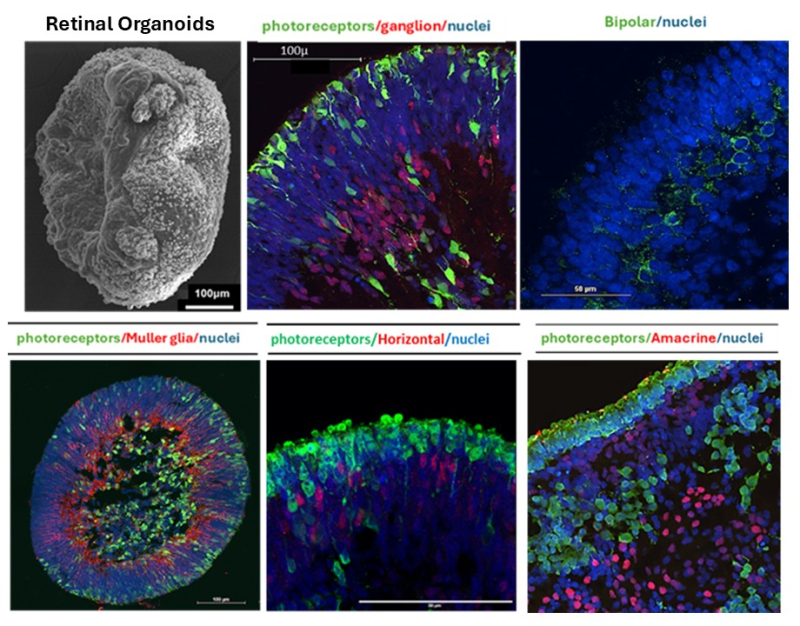
Retinal Organoids
It has been recently shown that the dysfunction in the relationship between the neuroretina and the vascular system (neurovascular unit-NVU) plays a crucial role in the pathophysiology of retinal diseases such as diabetic retinopathy and age-related macular degeneration. In vitro retinal model development has gained momentum due to the inadequacy of animal models in replicating the structure and function of the human retina.
Regenerative Medicine - Tissue engineering

Diffusion is a limiting factor in regenerating large tissues (100-200 μm) due to reduced nutrient supply and waste removal leading to low viability of the regenerating cells as neovascularization of the implant by the host is a slow process. Thus, generating prevascularized tissue engineered constructs, in which endothelial (ECs) and mural (MCs) cells, such as smooth muscle cells (SMCs), and pericytes (PCs), are preassembled into functional in vitro vessels capable of rapidly connecting to the host vasculature could overcome this obstacle.
Markou M, Kouroupis D, Badounas F, Katsouras A, Kyrkou A, Fotsis T, Murphy C, Bagli E. Tissue Engineering Using Vascular Organoids From Human Pluripotent Stem Cell Derived Mural Cell Phenotypes. Front Bioeng Biotechnol. 2020 Apr 17;8:278. doi: 10.3389/fbioe.2020.00278. PMID: 32363181; PMCID: PMC7182037.
VEGF Signaling
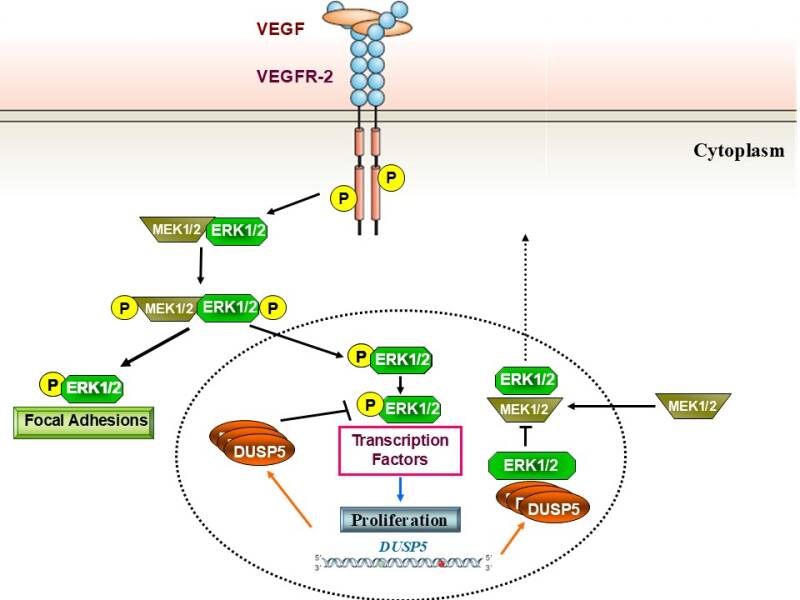
In endothelial cells (ECs), during angiogenesis, several downstream signalling pathways are activated upon VEGF-A/VEGFR2 complex formation, which regulate EC proliferation, migration and survival. In angiogenesis each process is regulated by a dedicated pathway.


Endocytic trafficking and growth factor signaling
Ligand/receptor complexes formed at the plasma membrane are internalised via various endocytic pathways that influence the ultimate signalling output by regulating the complex’s selection of interaction partners along the trafficking route.
Angiogenesis
Angiogenesis involves the formation of new vessels from pre-existing ones, mainly by sprouting angiogenesis, being regulated by VEGF as well as the angiopoietin system, PDGF and TGFβ.

Vasculogenesis
Vasculogenesis is the fundamental developmental process, during which mesodermal progenitors are differentiated to endothelial cells (ECs). The initial vessel plexus, formed from ECs only, further matures via the process of vascular myogenesis, during which mural cells (MCs), such as pericytes (PCs) and vascular smooth muscle cells (vSMCs), are recruited to the vessels via cross-talk with ECs differentiating locally. Such mature vessels consisting from ECs and PCs/SMCs can form new vessels using spouting in a process called angiogenesis.

Unfolded protein response & ER stress
Accumulation of unfolded proteins in the endoplasmic reticulum (ER) initiates IRE1α, ATF6, and PERK cascades, leading to a transcriptional/translational response known as unfolded protein response (UPR). We have shown that VEGF activates UPR mediators through a PLCγ-mediated crosstalk with the mTORC1 complex without accumulation of unfolded proteins in the ER. Activation of ATF6 and PERK contributes to the survival effect of VEGF on endothelial cells (ECs) by positively regulating mTORC2-mediated phosphorylation of AKT on Ser473, which is required for full activity of AKT. Low levels of CHOP allow ECs to evade the proapoptotic effect of this UPR product. Depletion of PLCγ, ATF6, or eIF2α dramatically inhibited VEGF-induced vascularization in mouse Matrigel plugs, suggesting that the ER and the UPR machinery constitute components of the VEGF signaling circuit that regulates EC survival and angiogenesis, extending their role beyond adaptation to ER stress.

Mediterranean Diet and Cancer
Epidemiological and other studies have shown that the plant-rich Mediterranean Diet (MD) protects people against cancer and many chronic diseases. MD is characterized by increased consumption of fresh fruits, vegetables, nuts, unrefined grains/legumes, and olive oil, moderate consumption of fish, dairy products, and red wine, and low consumption of red meat.
